Trolls
Vainqueur the DragonTrolls occupy a deliberately unstable place in the world of the novel. They are feared as powerful monsters and hunted for money, yet they also possess military histories, social ties, technical professions, and political interests. Their appearances repeatedly challenge the assumption that a sentient creature can be reduced to a bounty, a food source, or an obstacle to settlement.
Identity and Social Presence
Trolls are presented as intelligent beings who live in organized groups and can participate in human and monster economies. Their communities include warriors, mercenaries, artisans, and workers, while individual trolls can negotiate employment, discuss past events, and understand the consequences of political violence. The narrative therefore treats “troll” as a species identity rather than a single moral category: some trolls are raiders, some are refugees, and some become productive members of Vainqueur Knightsbane’s administration.
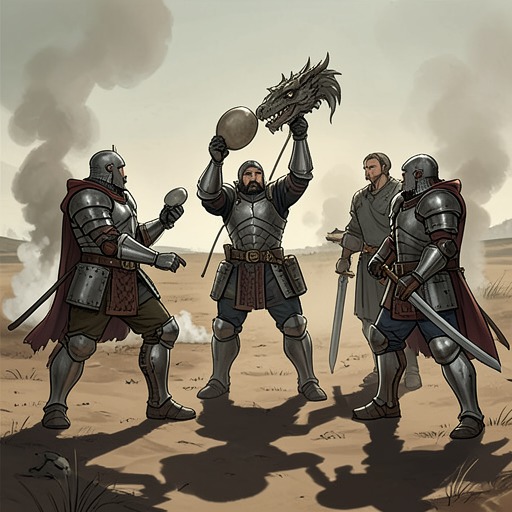
Their physical presence is associated with danger and strength. The Branded Barks, a clan of trolls, sack the lands of the Count of Provencal and hide in the Woods of Gevaudan. The Adventurer Guild classifies exterminating them as a difficult quest, and Victor Dalton explains that they are war trolls, brought by Prydain during the great war, crafty and strong. Their history makes the bounty more than routine pest control: these trolls are remnants of a military conflict who have survived by turning to violence and concealment.
Hunts, Bounties, and Dragon Violence
The Branded Barks become an example of how the adventuring economy converts violence against sentient monsters into paid labor. The Count offers a substantial reward for their extermination, and Vainqueur immediately focuses on whether killing trolls will grant experience and levels. When he learns that the task is worth six thousand gold coins, the monetary value of the quest becomes inseparable from its violence. The trolls are simultaneously described as criminal vermin, difficult opponents, and a profitable route to advancement.
Vainqueur’s response also reveals the species hierarchy governing his conduct. He mocks the fear of trolls and treats their strength as evidence of the weakness of “manlings,” but he does not initially approach the woods as a conventional adventurer. He refuses to search through troll caves because he will not sully his scales with their dung. Instead, he flies over the forest, detects trolls, slimes, and other beasts below, and dives toward the woods after igniting the infernal power in his stomach. The resulting image makes the dragon’s intervention less like a quest than an aerial act of overwhelming predation.
The same pattern appears in the wanted notices for Gustave La Muraille and his fellow war criminals. Victor describes Gustave as a former Gardemagnian soldier who leads twenty soldiers and is wanted for sacking a village and massacring eighty-seven inhabitants. The evidence does not identify Gustave’s warband as trolls, but it places the troll hunt within a wider frontier economy in which soldiers, monsters, and criminals are all measured through levels, body counts, and gold rewards. Trolls are not outside civilization in this system; they are one of the populations through which its institutions define danger and profit.
Survivors and the Case of Barnabas
Barnabas gives the species its clearest individual voice. When he appears during Victor Dalton’s recruitment process, Vainqueur recognizes him as a troll and admits that he has recently burned many of them. Barnabas confirms the consequence directly: Vainqueur destroyed the Woods of Gevaudan and killed everyone Barnabas knew there. His bitterly comic remark that he hated those people does not erase the scale of the loss; it establishes Barnabas as a survivor whose personal history has been transformed by the dragon’s campaign.
Barnabas is not recruited as a warrior. He is level twenty-one, with Blacksmith, Merchant, and Alchemist classes, most heavily developed in Blacksmith. He makes weapons rather than wielding them, and Vainqueur immediately hires him as the official armorer, ordering him to work on dragon-sized equipment. Barnabas asks for new raw materials and points to the pile of items produced during Vainqueur’s training. This exchange converts a supposed enemy species into a specialized labor force, while also showing that troll expertise can be useful to a dragon empire even when troll military power is feared.
Barnabas’s employment complicates the meaning of the earlier extermination quest. The same species that supplies experience and bounty money also supplies professional knowledge necessary for the construction of Vainqueur’s power. The novel does not resolve this contradiction through a moral conversion in which all trolls become innocent; instead, it preserves the tension between exploitation, survival, and practical interdependence.
Trolls on the Imperial Frontier
The Woods of Gevaudan and the territory around Vainqueur’s castle form a frontier repeatedly remade by violence. The castle stands beside a large volcano and the western sea, but the surrounding countryside is a poor landscape of badlands, arroyos, scarce vegetation, and the beginning of a vast red desert. A small village remains at the mountain’s foot, while primitive encampments lie near the desert’s border. Vainqueur remembers the region as much greener two centuries earlier, linking the present scarcity to a long history of environmental and political change.
The southern encampments belong to gnoll tribes who lived under the rule of Furibon. Trolls are not the only displaced or subordinated monster population in this region, but their fate helps establish the same frontier pattern: monster communities are driven from their habitats, judged according to their association with rulers, and then absorbed into a new regime. Vainqueur destroys the Woods of Gevaudan, while survivors such as Barnabas must find a place within the expanding Castle of Murmurin administration.
The broader history of the southern continent intensifies this pattern. The Sablaris Empire once ruled much of the southern continent, Ishfania, and Barin, until its cultists caused a magical cataclysm that turned the empire into a red desert. Brandon Maure later ruled the ruins of Ishfania with summoned monsters. These facts place troll communities within landscapes repeatedly transformed by imperial conquest, magical catastrophe, and monster governance rather than treating their habitats as naturally empty wilderness.
Food Chain, Reproduction, and Moral Contradictions
Trolls also appear within Vainqueur’s “preciousness” and food-chain doctrine. Vainqueur tells Victor Dalton that Victor stands directly beneath him in the hierarchy of preciousness, even above princesses, because Victor is nearly an honorary part of the dragon’s hoard. He then explains that the rating also determines who may eat whom, claiming that hungry dragons may consume lower-ranked minions as emergency rations. Trolls, like other sentient monsters, therefore exist within a framework where social value, possession, and edibility overlap.
The reproductive advice Vainqueur gives to Victor extends the same economic logic. He says that a creature seeking a mate should display the size of its hoard, and that prospective parents should avoid paupers who cannot care for eggs. Although the remarks concern dragons and other minions rather than a specific troll custom, they establish the ideological environment in which trolls are assessed: wealth, usefulness, strength, and position in a hierarchy determine whether a being is protected, employed, hunted, or eaten.
The novel exposes the inconsistency of this system without making Vainqueur abandon it. Jolie argues that sentient beings have souls and that eating them or abducting their princesses is morally wrong. Vainqueur grants an exception to elves while Victor points out that elves are people too. Later, when a fomor invites him to exterminate mortal races in exchange for fairy gold and mortal flesh, Vainqueur refuses because killing all his favorite food would eliminate the coins and princesses on which his hoard depends. Trolls thus belong to a moral economy that is partly challenged by the narrative but still administered through appetite, property, and convenience.
Narrative Significance
Trolls provide one of the clearest tests of whether the world’s categories can withstand contact with individual lives. At a distance, they are a difficult quest worth six thousand gold coins; in military records, they are dangerous war trolls; from the air, they are shapes beneath a forest ready to be burned. Barnabas changes that scale of vision. He is a craftsman with multiple classes, a survivor of Vainqueur’s destruction, and an employee whose expertise helps build dragon-sized institutions.
Their role also supports the novel’s frontier and anti-romantic treatment of empire. Territories are declared empty or impoverished, monsters are displaced, fortresses are rebuilt, labor is recruited, and treaties convert conquest into recognized sovereignty. When Gardemagne offers to recognize Vainqueur as Emperor of Ishfania and preserve his access to the Adventurer Guild in exchange for mutual protection, the political system formalizes the seizure and administration of monster-inhabited spaces. Trolls are not merely creatures encountered on the road; they are part of the populations through which borders, authority, labor, and legitimacy are negotiated.
The species therefore embodies the book’s recurring collision between adventure-game mechanics and lived consequences. Levels and rewards make extermination legible as progress, while Barnabas’s testimony restores the erased history behind that progress. Trolls remain capable of violence, but the narrative refuses to let violence be their only defining fact. Their strongest significance lies in that contradiction: they are prey in one scene, victims in another, and skilled participants in the empire that replaces the world they lost.